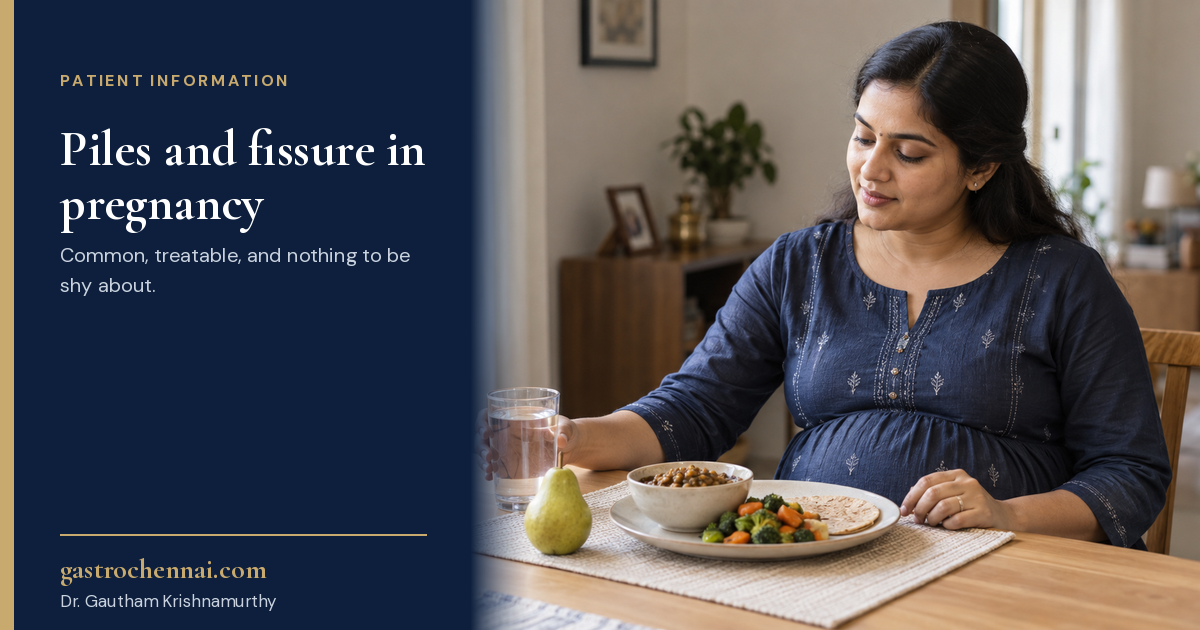
Piles and an anal fissure are among the most common problems of late pregnancy, and among the least talked about. Women often put up with them for weeks, partly out of embarrassment and partly from a fear that anything they take will harm the baby. Both of those are avoidable. This is a plain account of why it happens, what genuinely helps, which medicines are reasonable and which are not, and the small number of situations in which you should be seen the same day.
The Short Answer
Most of it settles on its own after delivery. The treatment that works is not a tube of ointment but keeping the stool soft and not straining: fibre, fluid, and not sitting on the toilet for long. Paracetamol is fine for pain. Ibuprofen and codeine are not the ones to reach for. Before you start any laxative or any ointment, including one bought over the counter, tell the doctor or midwife looking after your pregnancy.
Do not assume that bleeding is piles just because you are pregnant. Most of the time it is, but that is a conclusion for someone who has examined you, not an assumption.
Why Pregnancy Brings This On
Three things happen at once. The hormones of pregnancy slow the bowel, so stool becomes harder and drier. The growing uterus presses on the veins that drain the back passage, so they swell. And iron tablets, which most women are taking, make constipation worse.
Then comes delivery, where the pushing stage does in an hour what months of straining would do. This is why so many women find that a problem which was manageable through pregnancy becomes much worse in the first days afterwards.
Both problems come from the same place. Piles are swollen veins in the back passage; they bleed, they itch, and sometimes a lump appears outside. A fissure is a small tear in the skin of the anal canal, usually caused by one hard stool; it gives a sharp, burning pain during and after passing stool, often with a little bright red blood on the paper. A fissure hurts far more than its size suggests.
How Common Is It
Common enough that it should be asked about at antenatal visits and often is not. In one study that followed 280 women through pregnancy and after childbirth, around 4 in 10 developed piles or a fissure. Symptoms most often began in the last three months, in about 6 in 10 of the affected women, or in the first day or two after delivery, in about 3 in 10.
Piles are much the commoner of the two. Fissures happen, but far less often, and they are frequently mistaken for piles because both bleed.
The single risk factor you can do something about is constipation. That is the whole reason the boring advice below is the actual treatment rather than a preliminary to it.
What Actually Works
In a study of pregnant women with these problems, the simple measures did most of the work. Warm salt water baths helped 20 of the 22 women who tried them. More fibre helped 51 of 58. More fluid helped 55 of 63. Only one woman in that group needed an operation while still pregnant.
- Fibre, at every meal rather than in one go. Vegetables, fruit with the skin where it is edible, whole pulses, and a wholegrain in place of a refined one. Adding fibre suddenly causes bloating, so build it up over a week or two.
- Fluid, about 1.5 to 2 litres a day. Fibre without fluid makes stool harder, not softer, which is the opposite of what you want.
- Warm water, twice a day and after passing stool. Sit in a basin of plain warm water for ten minutes. It relaxes the muscle spasm that makes a fissure so painful, and it is the single most useful thing you can do for one.
- Do not sit on the toilet for long. Two or three minutes. Reading on the phone in there is a genuine cause of piles, and almost nobody mentions it.
- Do not strain. If nothing is happening, get up and come back later.
- Move. A walk most days helps the bowel more than most people expect.
- A cold pack wrapped in a cloth, for a swollen painful pile, for a few minutes at a time.
If you are on iron and constipated, say so at your next antenatal visit rather than stopping it yourself. There are usually ways around it.
Medicines: What Is Reasonable, What to Avoid
Very little of this is licensed for use in pregnancy, which is not the same as being known to be harmful. It does mean the decision belongs with the doctor or midwife looking after your pregnancy, not with the pharmacy counter. Take this section as background for that conversation.
For pain, paracetamol. Avoid ibuprofen and other anti-inflammatory painkillers in pregnancy unless your doctor has specifically advised one. Avoid codeine, which constipates, and constipation is the thing causing the problem.
For constipation, the safest first step is a bulk-forming laxative such as ispaghula husk. No harmful effects on the baby have been reported with this group. If that is not enough, lactulose or a macrogol is the usual next step; the information on these in pregnancy is limited but does not raise concerns, and they may be used if needed. Stimulant laxatives such as senna are a step further again, and the data are not strong enough for anyone to promise they are risk free. Laxatives can upset the body’s salts, so they are for short courses, not for months.
For the ointments and suppositories, the honest position is that none of them are licensed in pregnancy. Where one is used, a plain soothing preparation is preferred over one containing a steroid or a local anaesthetic, simply because there is less in it to worry about. Very little is absorbed from the skin there, and no harm has been identified from the products in ordinary use, but that is a reason not to panic if you have already used one, rather than a reason to start on your own.
A practical point for India: many of the tubes sold across the counter for piles contain a steroid, a local anaesthetic, or both, often without that being obvious on the front of the box. Take the packet to your appointment and let someone read the back of it.
When to Be Seen the Same Day
Go to hospital the same day, or contact your obstetric team, if any of these happen.
- Heavy bleeding, or bleeding with dizziness, breathlessness or fainting.
- A hard, very painful lump at the back passage that has appeared suddenly. This is usually a clotted pile, and it is most treatable in the first two or three days.
- Fever with pain or swelling near the back passage, or a discharge of pus. An infection there needs treating, not waiting out.
- Pain severe enough that you cannot sit, sleep or pass urine.
- Bleeding that is dark or mixed through the stool rather than bright red on the surface.
And the one that matters most: any bleeding in pregnancy should be mentioned to your obstetric team, even when you are fairly sure it came from piles. It usually did. Deciding that is their job, not yours, and it takes them a minute.
Will I Need an Operation?
Almost certainly not while you are pregnant. Operations for piles and for an anal fissure are deliberately put off until after delivery, and usually until after breastfeeding, because most of these problems shrink away once the pregnancy is over and the constipation settles. Operating on something that was going to get better anyway is a poor trade in pregnancy.
The exceptions are the acute ones in the list above, and they are uncommon: a clotted pile causing severe pain, or an infection. Even then the aim is the smallest procedure that solves the immediate problem.
If the problem is still there three months after delivery, that is the point to have it looked at properly rather than continuing with ointments.
After the Baby Arrives
The first week is often the worst, and then it improves steadily. Keep doing exactly the same things: fibre, fluid, warm water, no straining, no long sittings. Constipation is common in the early weeks after delivery, and it is what keeps a fissure from healing.
If you are breastfeeding, the same rule applies to medicines as in pregnancy. Ask before starting anything, including something you were given during the pregnancy.
Common Questions
Will piles mean I need a caesarean? No. Piles on their own are not a reason for a caesarean, and that decision is made on obstetric grounds.
Will they go away completely? Most improve a great deal and many disappear. Some leave a small skin tag that is harmless and needs nothing done. Piles that were present before the pregnancy are the ones most likely to persist.
Can I use a piles ointment I have at home from before? Check the packet with your doctor first. The problem is usually not the ointment but the fact that nobody has looked at what is actually causing the bleeding.
Is bleeding in pregnancy ever from something else? Yes, which is why it should be reported rather than assumed. Piles are much the commonest cause, but other causes of rectal bleeding exist at every age and pregnancy does not exclude them.
Do squatting toilets help? The position does make emptying easier for many people. A small footstool in front of a western toilet, raising the knees above the hips, achieves the same thing and is safer in late pregnancy.
The Bottom Line
Piles and fissures in pregnancy are common, miserable and mostly temporary. The treatment that works is unglamorous and free: soft stool, no straining, warm water, and time. Medicines have a place, but a small one, and the choice belongs with the team looking after your pregnancy. What should not happen is a woman spending the last three months of her pregnancy in pain because she was too embarrassed to mention it, or too worried to ask what she was allowed to take.
Reviewed September 2026. This is general information and not advice for your own condition. Please see a doctor about your symptoms.
Still uncomfortable, or still bleeding after delivery?
Dr. Gautham Krishnamurthy provides consultation for piles, fissure and other bowel problems at P&G Hospital, Chennai. If you are pregnant, bring any ointment or laxative you are using so it can be checked. For appointments, contact reception.